
Value Groups
Productivity, capacity and their connection to time recording.
How does a service company tell how productive it is? The question is not that easy to answer. The challenge is to find a metric that is both meaningful and actionable.
At first glance, for example, profit or revenue seem to be good indicators of productivity. After all, they reflect the financial result of the company’s efforts. However, these key figures are a bit too abstract: how much revenue the company achieves is not down to employee productivity alone. Revenue and profit are influenced by factors that lie beyond the individual’s direct control – for example, market conditions, pricing strategies or cost structures.
Since this approach is too imprecise and can only be measured retrospectively, we use a productivity term in Leadtime that is based on what proportion of their working time employees spend on value-adding activities.
Value groups
To do this, all work in the company is divided into four categories (“value groups”):
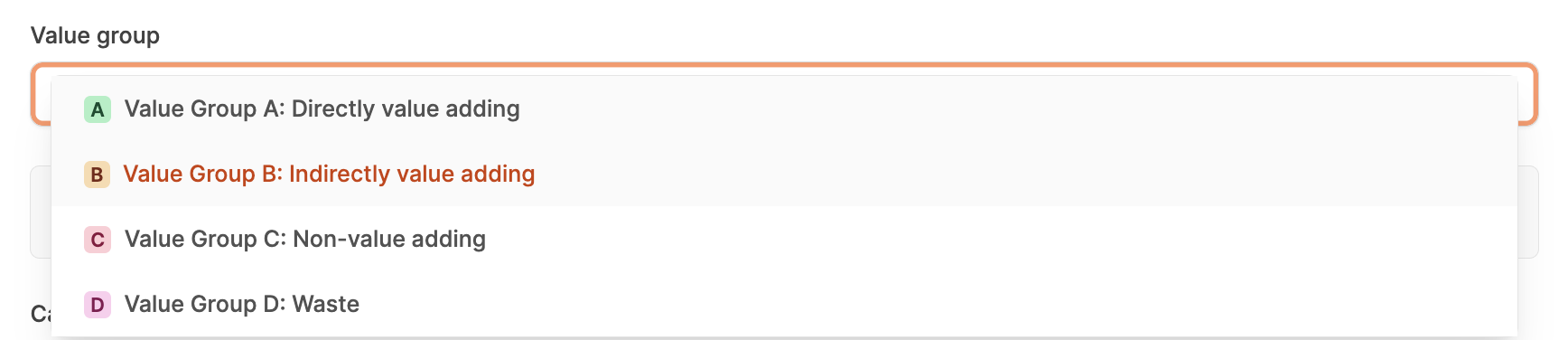
| value group | Description | Examples |
|---|---|---|
| A) Value-adding activities | Activities that directly contribute to generating sales and are immediately visible to the customer. | Development projects for customers, customer orders, services within the framework of customer projects. |
| B) Indirect value-adding activities | Tasks that do not directly generate sales, but support and optimize service provision. | Quality management, internal project planning, documentation, resource management. |
| C) Administrative activities | Tasks that are necessary to manage and maintain the company but do not provide direct customer benefit. | Bookkeeping, accounting, human resources management, internal meetings. |
| D) waste | Loss of time or activities that do not generate added value for the company or customer and should be avoided or reduced. | Unproductive waiting times, technical disruptions, inefficient processes, unnecessary meetings. |
Which value group a project falls into can be defined in the project settings Projects → [Select project] → Settings tab
High productivity
High productivity means that employees spend a large part of their working time in value group A, i.e. value-adding activities.
This makes it possible to monitor how productive the company is working in real time and quickly make corrections.
Your own time recording data provides a meaningful indicator of the quality of the work. This can be easily and promptly influenced and improved by employees. The focus is on the actual use of available working time, which enables a realistic assessment of productivity.
Dividing working time into value groups can help identify areas where time is wasted, thereby providing a basis for continuous improvement processes. In addition, it promotes an awareness of time management and prioritization among employees.
Capacity
The term Capacity refers to the contractually agreed working hours of an employee per week. This is usually the case for a full-time position 40 hours per week.
The Total capacity of a company is the sum of all individual capacities. A company with ten employees, each working 40 hours per week, has a total capacity of 400 hours per week.
Capacity planning takes place in Leadtime on a weekly basis, as the available working hours in the company are subject to ongoing fluctuations - for example due to vacation, illness or part-time arrangements. These changes are taken into account in the productivity measurement to ensure a realistic representation of the actual usable working time.
Ultimately, productivity – and therefore the success of a company – depends on how the available capacity is used. If, for example, an employee’s entire working time is used for billable customer projects, this corresponds to 100 percent productivity.
Time tracking in Leadtime
In order to achieve such an accurate measurement of productivity, we measure time on three levels in Leadtime:
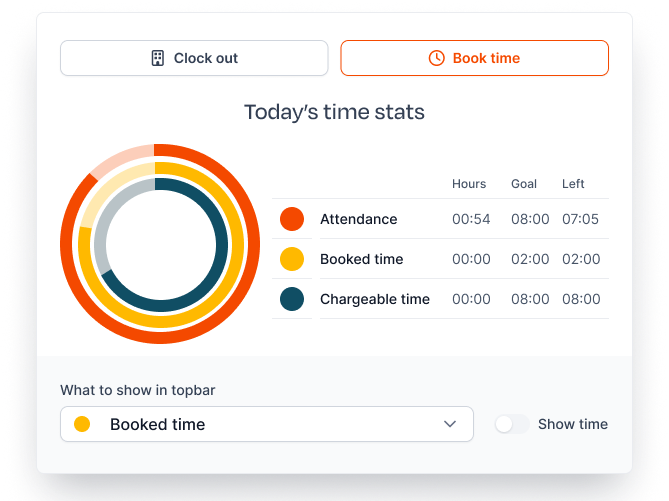
Attendance time
This refers to the time an employee spends at work. The employee checks into the system in the morning and checks out in the evening. This attendance time is compared with the contractually agreed working hours of the employee stored in the system. For example, if an employee is required to be present for 8 hours according to the contract, but is only present for 7.5 hours, this will result in 0.5 minus hours.
Attendance tracking (clocking in and out)
Documented working hours
Employees should document their entire attendance time by booking time on tickets and tasks. Leadtime compares the contractually agreed working hours with the ticket bookings made on the day. An employee with 8 hours of attendance who has booked a total of 6.5 hours on five different tickets has not documented 1 hour of office time.
Billable working hours
Here, daily goals can be set as to what proportion of their working time employees should spend on value-adding, i.e. directly revenue-generating, work. For example, it might make sense for developers to set a high value like 6 hours. This means that the employee should book at least 6 hours of billable time daily within their documented working hours.